



Conflict Res. at home

CONFLICT COMPONENTS - INTERESTS

WHILE WE ARE KEEPING SOCIAL DISTANCE AND HAVE A LOT OF TIME ON OUR HANDS, LET’S DO SOME CONFLICT RESOLUTION…

IMG_0546.jpeg

CONFLICT COMPONENTS - INTERESTS

Focus closely on Interests

Its the 39th day of our Working From Home daily message. And if you forget all 38 previous messages, remember this. The key to conflict resolution is understanding interests. Once you get this concept, conflicts start to make sense. If a person takes on the simple and profound concept of interests, its like the windshield becomes clear after having been previously fogged and the contours of the conflict landscape come into view.

What interests are not

Interests are not positions.The two are paired traditionally in conflict resolution training, because to understand one helps to explain the other. Let's look at Langley the pygmy goat, standing on my porch against my wishes last summer. What's his position? I want the day lilies. And the forsythia and whatever that is in the terracotta pot. And I want to stand on the porch. What's my approach? First of all you have to know that goats are hard to scare or influence, so yelling or sweet talking doesn't work. I do know a bit about Langley, though. He has two interests that usually motivate him. Food and curiosity, usually in that order. Knowing his interests, I offer him some goat feed and I start walking into another part of the yard. Appealing to his interests--I like that food a lot, and I wonder where she is going--helps me to get Langley to follow me off the porch.

In this conflict between my interests - the goat should stay in his pen and I want my day lilies to survive - and Langley's interests described above, I do not act to fight against his position. To do that, by the way, requires grabbing him by his horns, holding on to his collar and pushing with my whole body to make him go where I want. Instead I look underneath his position to see if I can can appeal to his interests. His interests are not specific to day lily leaves, so providing him with the feed satisfies his food interests. A win-win all around. Langley follows me around the yard--his curiosity interest - until he is safely back behind the gate in the goat yard having enjoyed his walk and his snack.

What are Interests, and Why Do They Matter?

An excerpt from MWI's Chuck Doran and Megan Winkeler blog describes positions and interests in non-goat terms.

Let’s say a person walks up to you and says, “I want you to give me $20!” Not knowing this person, you tell him no. Or, maybe you say yes. Either way, the demand for $20 is the person’s position. Positions are requests or demands to which you can say yes or no. In response to the person asking you for $20, you can choose to approve or deny this request. You might add other demands of your own – “I will give you $20 if you help me unload my groceries” or “I will not give you $20 unless you agree to buy me lunch next week.” The demands you add are your positions in the negotiation.

We express positions in a variety of ways, sometimes framing them as an immediate need or the only available option. To identify a statement as a position, ask yourself: can I say yes or no to this? Try it with a few examples below, which show how someone might frame their position.

  • Can I have $20?

  • I want $20.

  • I need $20.

  • Give me $20.

  • You are going to give me $20.

Note that you can say yes or no to all of these statements. They are all demands or requests made of you by the other person. Of course, you can choose to respond to the demand for $20 in other ways than a simple yes or no. In fact, you probably have an innate desire learn more about why this person is asking for $20. The answer to that question – why do you want $20? – defines the person’s interests. Let’s look at some possible responses from our fictional negotiator:

  • I’m hungry, but I lost my wallet and need to buy lunch.

  • I spent all my money on scratch lottery tickets expecting it to be a good investment, and now I can’t afford to buy a bus ticket home.

  • Last week I loaned you $20, and you haven’t paid me back.

  • I’m your thirteen-year-old son who does not have a job, and I would like to go to the movies with my friends.

Each of the statements above express interests. I want to buy lunch because I’m hungry. I want to get home, and the bus is the best way I know of to do that. I want to be made whole for the money I loaned you. I want to go to the movies with my friends. None of these statements are requesting anything of you. Rather, they are telling you what motivates the other person in the negotiation. In short: interests tell us why we are negotiating with someone. They explain what motivates us and what need we’re hoping to fulfill. Positions, on the other hand, demand or request something from our counterpart to fulfill those interests.

Positions and Interests in your daily life
conflict-transformation-amp-integrated-conflict-management-systems-4-728.jpg

Do you have a Langley standing on your porch in real life? Interest-based negotiation allows us to improve relationships. The son and daughter in the positional bargaining yelled, fought, and walked away resenting the other. The son and daughter, in the alternate interest based conflict resolution, considered each other's interests, figured out how to help the other person to reach their interests, and both left happy and with an intact relationship.

People fight hard for their positions because they have no experience with the process of looking underneath demands to uncover the underlying interests. They hold to their positions because they believe it may be the only way to meet their needs. Intransigence is fairly often fueled by lack of experience or imagination that there may be other ways to resolve the conflict. The rule is, you can't negotiate between positions, yet you can negotiate between interests.

How do you get to interests?

This is a lifelong mystery and puzzle that can occupy your thought process. People are unpredictable and amazingly surprising in their complexity. Go humans! Go complexity! Use your question asking skills and thoughtful detective work to see if you can figure out what the interests are that are fueling someone's positions. Impress your friends and family with your amazing and intuitive ability to understand where they are coming from by detecting their interests. In so doing you will have created an environment where conflicts can be resolved and mutual understanding can be built together.

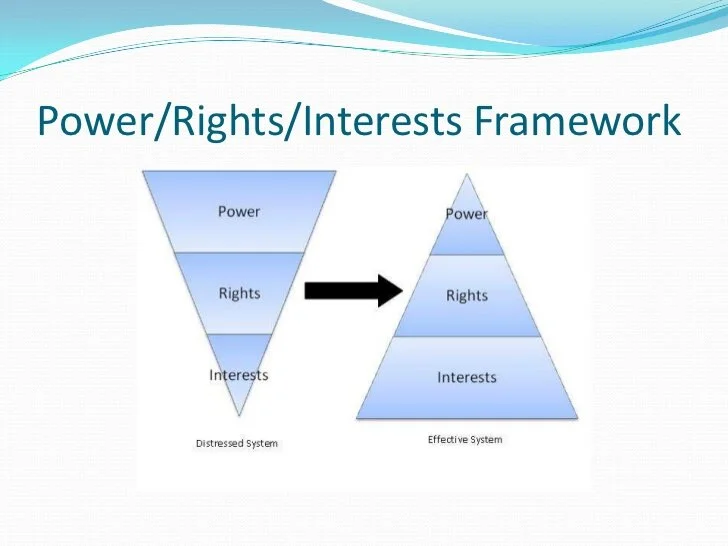
As the image above shows, the best structure is when power becomes a more minor player in the conflict resolution process and interests are what disputants emphasize as they work things out together. The pyramid on the right is grounded, balanced and strengthened by attention to interests. In your workplace, family, organization, which of the two depictions fit your situation? If you want to have a more healthy and productive structure, don't focus on positions but look more deeply to find the individual and collective interests.

Do this:

  • Do you remember the story of the orange conflict? Look at it again to consider positions and interests video.

IMG_1830.jpeg

WEDNESDAY SKILLS - BODY LANGUAGE

WHILE WE ARE KEEPING SOCIAL DISTANCE AND HAVE A LOT OF TIME ON OUR HANDS, LET’S DO SOME CONFLICT RESOLUTION…

puzzlehands.jpg

WEDNESDAY SKILLS - BODY LANGUAGE

Add this tool to your toolbox

Your body language has a major effect on conflict

Body Language

Ok we are going to talk about body language. No don't click off. Yes talking about body language means we are going to talk about bodies. So let's get this out of the way first.

You have a good body. It is not too big, or too small. Its just exactly tall enough and your chin is really fabulous just the way it is. Your skin is really quite wonderful in its exact wrinkliness, its hue is absolutely gorgeous. Your bald head, your warts, the grey, the roundness of your nose, your feet--all of it is just terrific. Forget all those other messages that are designed to make you feel diminished. Your body is just fine and you can make good use of it in conflict resolution.

Still here? Great. For something so important, so obvious, we spend a amazingly little amount of time focusing on how to use our bodies to best effect in resolving conflicts. We idolize the athletic achievements, the artistic use of the body, the performers. So let me ask you this, when has someone commented that your have communicated so well with the way you sat in the chair, how you leaned forward in just the right way, the method of using your eyebrows and that expressive squint. Let's get better at using the most crucial tool in our toolbox--our bodies.

Facial expression

Anthropologist Ray Birdwhistell estimated we can make and recognize around 250,000 facial expressions. Which ones are your best? This generation is perfecting the selfie culture. Those facial expressions are often designed to help others to see each other as attractive and friendly. Which other facial expressions are in your repertoire that you can call upon when you need them? Today while we are holding so many of our meetings on video conferencing, if you are able to record yourself, you might have a great set of data to study.

A very experienced mediator saw himself on video. "Do you mean that is what I look like the clients? Why didn't anyone tell me that all you can see is my eyebrows and glasses," he inquired. And we probably should have mentioned it before. As the parties sat in mediation, the combination of his reading glasses and brows meant that the parties were unable to connect with him face on. A conscious adjustment over time meant he was able to use his face and connect in a more effective way.

Neutral facial expressions and micro expressions

Holding your face in a neutral and relaxed expression is a useful skill to have. It takes some strong training. Once you have the capability to hold a neutral expression, it will come in handy in life as well as conflict resolution. Have you been told that everyone always knows what you are thinking? Then you have more work to do. We all have tiny muscular movements in our faces, called micro expressions, and they are easily picked up on by others. To have a neutral expression, your thought process might need to be neutral. After millions of years of evolution, our species has survived by picking up clues from others. If you clear your mind and reserve judgement, your facial expression is likely to follow.

To relax your face, do some facial stretches. Squinch up all your muscles, count to 5 then relax for 10. Do this a few times. Then open your mouth as wide as possible for 5 and then relax for 10. Just these two exercises, taking about 5 minutes at most, can help your face to relax and show your open mind to others.

Be careful not to mirror other's expressions

Others yawn, you yawn, right? We all mirror others, its a natural human process. When you find yourself in a conflict situation, you may notice others with facial expressions that indicate their thoughts, emotions and judgements. Be careful not to mirror other's expressions. such as:

  • Tightness around mouth and eyes

  • Frowning, scowling, and glaring

  • Lowered eyebrows

  • Tense jaw

  • Glaring intently

Awareness and avoidance of expression mirroring, can help to support a positive conflict resolution process. One person's expressions are difficult. When both people use these expressions, the conflict can devolve into aggression and/or distrust. Better to keep a calm and open face that invites conversation.

Gestures

We have all developed habits for use of our hands and arms when communicating. Much of this is cultural, some is un-examined. No matter where your habitual gestures come from, there are a few that are generally difficult and can undermine a peaceful communication such as:

  • Pointing and jabbing fingers

  • Crossed arms and legs

  • Clenched fists

  • Quick and jerky moves

  • Banging the table

  • Shrugging or dismissive moves

  • Hands on hips

None on this list should be considered forbidden. Instead develop an awareness of your use of these gestures. Know that they can have a powerful effect on the receiver and may be at cross purposes to the conflict resolution process.

There are some helpful gestures that can be supportive during a difficult conversation. Try:

  • Head nodding with understanding and acceptance

  • Open hand gestures

  • Arms uncrossed

  • Chest exposed

  • Slow, deep breathing

If you tend to have uncontrolled gestures, you might want to work on this. Try the last bullet above if you can't do anything else. A little oxygen helps everything to go better, and your brain gets what it need to be more aware.

Body and stance

There's a reason the judge is up high above everyone else in the court. This stance indicates the elevation of the judge role. The judge is the decider for others, its not a mutual process. If you, however, want to develop a mutually agreed upon outcome, make sure you are eye to eye and at an equal or lower level. If your social role might tend to convey a higher status upon you, try getting slightly lower in order to create an equal playing field. If you are tall and have to look down on people when standing, see if you can find a stool or table to lean on to become eye to eye. No one likes to be loomed over, and even with the best of intentions our natural reaction toward keeping ourselves safe, can hinder collaborative dispute resolution.

Squaring off your body to the other person is another aspect to for awareness. When you see someone only showing you their side and turning away, it may be interpreted as a lack of comittment or fear of interaction. If you want to show you are sincere and open, open up your torso to the other person and sit up, not rigid, showing the interaction is important to you. Slumping can mean you find the situation unimportant. Stretching your arm out over other chair backs or behind others can come across as aggressive. Bending over and looking down, can show timidness or a lack of willingness to interact. A lot to think about. As with any self improvement, awareness and intention is the place to start.

Here's a list from the Talented Ladies Club (love the name), article link is below. Its a helpful list, don't you think?

  • Uncross your arms. A crossed arms posture can show contempt, act as a barrier or show disinterest.

  • Relax, but not too much. Keeping a straight back but relaxing the shoulders shows attentiveness and stifles the raised shoulders of feeling tense. Relaxing too much and slouching might indicate disinterest.

  • Maintain eye-contact. This shows interest and is a sign of respect. Blink and look away momentarily (to prevent staring) but look at the person speaking as much as possible without it becoming uncomfortable.

  • Make relaxed movements. When we are feeling alarmed or confronted we can often make fast and jerky movements with our hands and body. If we are relaxed our body tends to relax. Try to keep your body relaxed even though you might not be feeling calm.

  • Signal non-aggression. Generally ‘squaring’ up to someone can signal aggression. By standing slightly side on and using open hand gestures you are signalling non-aggression. Just because you might not be an aggressive person does not mean that you would not be signalling aggression.

  • Get the distance right. Whether sitting or standing it’s important to be close enough to show a willingness to engage, but not so far that you become out of touch. A position of around four feet or so from the other person shouldn’t occupy their personal space and should feel comfortable for both.

  • Smile and nod. The occasional smile shows an air of warmth but it should not be false. It may only need to be for a second, but it should be genuine. An accompanying nod affirms the smile and can infer agreement.

The real trick is develop body language awareness. First pay attention to what you have to learn and improve. Then start looking at other's body language, and see if you can pick up on some of these moves. Turn the sound off on the TV or watch in a language you can't understand, and try to see what you can pick up. Use what you've got, your body, and there's a lot your body, face and gestures can do to help things along.

Do this:

  • Record yourself. Do you like what you see? Pick one specific goal that will help you come across in the way you intend. Keep recording. Or ask a partner to watch you more carefully and give you feedback.

  • Working on confidence, this might help.

  • First chapter of Definitive Book of Body Language.

  • The Talented Ladies club is for ladies and others.

  • Lots of pictures here.

  • Very quick video showing your body posture changes your body chemistry and thoughts.