


No More Shame and Blame: Want to fuel conflicts? Try shame and blame.

WHILE WE ARE KEEPING SOCIAL DISTANCE AND HAVE A LOT OF TIME ON OUR HANDS, LET’S DO SOME CONFLICT RESOLUTION…

blameeconomist.jpg

NO MORE SHAME AND BLAME

Want to fuel conflicts?

Try Shame

and Blame

  • He did it!

  • Its all your fault!

  • When I find the culprit I'm gonna...!

  • You should be ashamed of yourself!

Here's the thing about employing the shame/blame dynamic duo. They don't solve the conflict. They don't analyze the problem. They don't help us to learn from our mistakes. They make people miserable and accomplishing next to nothing. They don't build trust. Blame and shame culture will harm any relationship or organization in short order. Blame and shame does nothing but make folks feel bad.

So why are we living in blame/shame culture? Its not entirely clear. There's some anthropological and historical conjecture about our species' approach toward individuals who veer from the group or who harm others. There does seem to be an epidemic going on. Present day self-help and support articles attempt to help people whose lives have been ruined by intensive blame/shame. For whatever reason it exists, let's move beyond it.

Blame/Shame use in conflict

Louise has a conflict with Marian. Louise says to Marian, You did this awful thing. Its all your fault!

What might be Louise's reason for saying that?

  • Louise wants to make Marian feel bad.

  • Louise wants to get Marian to take responsibility.

  • Louise is so angry and thinks saying this will make her feel better.

  • Louise has had others blame her and thinks that's what she should do.

No matter the reason Louise says it, it does not do any work in the conflict. By blaming Marian, she is shutting down any possibility for an open dialogue. Maybe Marian did do that awful thing. And how does blaming help the situation? Louise's blaming her puts her in a defensive position, having to protect herself or to hurt Louise back. And then? Nothing is accomplished.

Blame and shame have lifelong effects. Think of the times it has happened to you. Some have a childhood or adult full of blame/shame. It is a depleting and dehumanizing experience to be blamed and shamed.

The person is negatively affected. The blamer is also negatively impacted, in that the process leads to a dead end. Hurting others, making them feel bad about themselves, creating an atmosphere of fear does not build anything positive. Individuals who insist on blaming others, and in so doing shaming those who are targeted, tend to be power oriented and quick fix thinkers. In the end, they do not make things better.

In the article below this quote is highlighted, “The only thing people learn from being blamed is to become better at hiding their mistakes.” If that's your goal, go ahead--blame and shame away. But if you want to create a positive, learning culture, here's a great comparative figure showing the differences between an environment that is working toward mutual accountability and the blame/shame culture.

So what to do?

If you want to resolve a conflict, move your thought process away from blame and toward problem solving. Can you ask a question? Can you listen? Can you find something to learn from the situation? Can you lend a willing ear to let the other person work things out, take responsibility, apologize, face their mistakes? People do not tend to open up when they think they are not safe. Be the safe person who is making a connection and trying to figure things out with the other person. Put the blame/shame away locked up tight. If this is the other person's worst day, don't you want to be the one who says, "We all make mistakes. I do too. Let's see what we can do to fix this."

In conflict resolution, the mediator, coach or facilitator has to work hard to move the person who is intent on blaming. Until they advance past blaming, a resolution is unlikely. Sometimes it takes asking the right question such as:

  • How could this problem be avoided in the future? 

  • What can be done support learning from this experience?

  • What do you want from the other person, and what can they do to make it right?

  • Do you want to resolve this?

Try to do what you can, at least notice where blame/shame rears its ugly head and name it when you see it. Try this: "Let's not blame and shame. Instead lets look to the future and not try to hurt each other." Sometimes that's all it takes, to point things out for what they are.

Do this:

  • Blame and shame culture in the workplace article

  • Culture of accountability instead of blame article

  • Blame and shame in relationship conflicts article

DON’T TAKE IT PERSONALLY: In conflict situations, try not to personalize

WHILE WE ARE KEEPING SOCIAL DISTANCE AND HAVE A LOT OF TIME ON OUR HANDS, LET’S DO SOME CONFLICT RESOLUTION…

images (1).jpg

DON’T TAKE IT PERSONALLY

In conflict situations,

try not to personalize

You have a conflict and are trying to sort it out. What can you take responsibility for and what does not really belong to you? You are trying to be honorable and honest with yourself and the other person--you might have been at fault for some of it. Is there something you can apologize for? What about the other person, do they have some responsibility too? Do they see things differently than you? Can you learn more by talking to the other person? To a trusted ally? What should you do?

One important thing to do is to try not to take it personally. In this context taking it personally refers to the negative self talk that can happen when we over-personalize difficult situations. Some of us can beat ourselves up. When you take things personally, your ability to resolve the conflict is dramatically diminished.

An example

Here's a story from the article linked below:

The other day I was in a building running an errand. As I walked through the lobby toward the exit, a woman I didn’t know walked past me. As she did she said, “Buenas”–which is a standard greeting–, and I answered, “Buenas”, and kept going. Then I heard the woman say: “You’re so rude. Learn some manners. When someone greets you, you should greet them back.”

I stopped and turned around, and I saw that the woman was talking to me. Obviously, she didn’t hear me when I answered her greeting. In addition, it was evident that she had concluded that I simply chose to ignore her, and she took it personally. Given her state of agitation, it was clear to me that she felt slighted. I told the woman that I had responded to her greeting, and it wasn’t my fault that she didn’t hear me. Then I left. What I really wanted to tell her was that she needed to learn how to stop taking things personally.

Whenever I walk into an elevator and there’s already someone in there, I say “Buenas”, because that’s a cultural practice in Latin America. Most of the time people answer my greeting. But sometimes they don’t. And when they don’t, I don’t take it personally.

In this story, it seems obvious that the quick public conflict was related to someone who was evaluating events through a super personalized lens. "Learn some manners..." is an assumption. It seems to come from a person who believes their immediate reading of a situation is fully accurate and worthy of comment. "When someone greets you...." indicating a grievance that comes from believing that someone has not treated this person respectfully. Quick to anger, quick to engage and in this case, inaccurate.

Reorient your thinking

Don Miguel Ruiz writes a lot about not taking things personally. He considers it to be one of four life rules for healthy living. He says, "Even when a situation seems so personal, even if others insult you directly, it has nothing to do with you. What they say, what they do, and the opinions they give are...(what)... they have in their own minds." We all have been negatively affected at one time or another by what others have said or done. The idea is to move through a kind of mental checklist in order to stay in reality and to work to be logical and thoughtful. A checklist like: I'm doing the best I can. Check. The other person may not see it the way I do. Check. What other explanations can there be? Check. Even if the other person doesn't do or say what I want, it may not be about me. Check.

Conflict and personalization

If you can move beyond taking things personally, you can be open to a new conflict narrative. You can be open to what is happening for the other person and be a learner. You can be self reflective and learn about yourself. You can be a willing partner in the process of working things out. Even if other people are personalizing the situation, you can have the intention of staying open and willing to be a creative thinker. This does not mean being a doormat. It means not internalizing others' opinions of you--or setting yourself up to be easily harmed by others. Hold to your own principles and stay open to what others can offer. Its not easy. In a conflict, don't take things personally.

Do this:

  • Watch a quick video showing the importance of this in workplace conflict video

  • Watch Oprah learn about not taking things personally video

ASK THE RIGHT QUESTION: Asking the right question can make all the difference in a conflict All kinds of questions

WHILE WE ARE KEEPING SOCIAL DISTANCE AND HAVE A LOT OF TIME ON OUR HANDS, LET’S DO SOME CONFLICT RESOLUTION…

bigstock-Question-Mark-114454214.jpg

ASK THE RIGHT QUESTION

Asking the right question can make all the difference in a conflict

All kinds of questions

In conflict resolution training, participants are taught the skill of effective questioning. Its important to learn how to structure questions, which type of question to use when, and the the effect of particular questions. There's an art to asking questions at the right time and in the right way.

Closed ended questions

Red pill or blue pill? Its a closed ended question. How do you recognize this kind of question? It can be answered with yes, no or one word. Would you like fries with that? Yes or no. A closed ended question is useful when someone needs to know a simple answer and wants to limit the information coming from the respondent. Close ended questions can have the effect of shutting down communication. They have a restricting aspect and generally do not help to deepen or solidify a relationship.

Probing or Clarifying questions

In a conflict, ask clarifying questions before coming to conclusions. A clarifying question serves many purposes. Here's one: Would you tell me more about what your reaction was? The person answering gets the chance to explain themselves--and knows the other person is interested in their thoughts and experiences. Here's another one: Could you repeat the second part again? The person asking shows they want to make sure they understand what has been said and the other person knows they are being listened to intently. Here's a clarifying question that helps to fill in the blanks, I think I missed it, can you tell me what happened on Tuesday? Instead of jumping to make a judgement, ask a probing question and listen to understand.

Open Ended questions

The most helpful type of question in conflict resolution is the open ended type. This kind of question cannot be answered with a single word answer. It invites open communication and sharing of ideas. If you don't tend toward open ended questions, here a few all purpose ones that can be used in almost all situations. Remember your tone and body language need to be matched to sincere inquiry--and listen fully to get the answer and the underlying information that comes from truly trying to understand the other person.

  • Can you describe what happened?

  • What would you like to see happen?

  • What does that look like for you?

  • What would it take for us to be able to move forward?

  • What ideas do you have that would meet both our needs?

  • What about that was important to you?

  • What’s the biggest risk of you not making progress?

  • Tell me what you are concerned about?

  • What’s important to you about that?

If you are not able to come up with one of these in the moment when you are trying to improve communication, here are question starters to begin an open ended question:

  • I wonder..

  • Help me to understand...

  • Could you expand on...

  • I'm curious about..

or the tried and true all purpose question:

  • Would you tell me more?

Accusations into questions

Lets say you have come to a conclusion or judgement and it sounds something like: You did this on purpose to hurt me! This accusation can be easily turned into a question, Did you do this on purpose to hurt me? Although the conclusion is part of it, the question comes across as a genuine inquiry, as long as its paired with a tone of voice that is calm. Asking this kind of question can serve to open up communication instead of shutting it down. Or instead of asking it as a close ended question, try an open-ended one: Could you tell me about why you did that? Did you have any thoughts about how it would affect me?

Why questions

Starting an open ended question with Why might seem like a great way to try to increase understanding. Some recent research calls this into question. Particularly in a conflict, it turns out, a person being asked a why question can hear it as an aggressive challenge. So use four of the five Ws--What, When, Where and How, but be judicious about using Why if you are trying to be delicate and not cause more conflict.

Do this:

  • Listen to your day to day questions and to those of others. Are you noticing open ended questioning around you?

  • Two articles about asking question in conflict here and here.

NEW ATTITUDE - FOCUS ON MUTUALITY

WHILE WE ARE KEEPING SOCIAL DISTANCE AND HAVE A LOT OF TIME ON OUR HANDS, LET’S DO SOME CONFLICT RESOLUTION…

images.jpg

NEW ATTITUDE - FOCUS ON MUTUALITY

Mutuality

is the way forward

We are all in this together. Its a phrase we are leaning on a lot in the present moment. There is nothing like a scary crisis to bring people together. We see mutual appreciation expressed effusively with the 7pm public clapping, singing, banging pots and pans. Have you heard about this? The nurses, doctors, cleaners and first responders are out trying to save humanity. Everyone else is sequestered in their homes across the country. At 7pm people come out to the balcony, or open the window or stand on their steps and make lots of noise. What they are saying is Thank you for helping! We appreciate you for doing your job to save lives! We are home and trying to stay safe and you are out there risking your life--but we have not forgotten you! We are proud of our fellow humans who are doing good!

The 7pm collective cheer is a demonstration of mutuality. Mutuality is a positive, interactive relationship between people.The word comes from mutual meaning given and received in a reciprocal way. Mutual is familiar language and its used in various ways such as:

  • mutual trust: promises kept, equality ability to count on one another

  • mutual benefit: life enhanced due to connection

  • mutual support: help each other and give each other aid

  • mutual admiration: have high regard and respect for each other

Mutuality is all of these wrapped up in the reciprocity of working to understand each other's perspective, interests and outlook.

Mutuality in conflict resolution

In mediation we work to help disputants to experience mutuality with each other. If there is a stand off, folks might need to let down their guard, work to listen better, put aside their assumptions, slow down. Once both parties are actively trying to resolve their conflict, the idea is to help them to develop some level of mutuality. This is important and sometimes has a dramatic effect. When someone walks in another's shoes, it can be profound. The mediator asks, 'can you describe where we are from the other person's way of understanding it?' It works.

In conflict coaching we ask the clients to pick a conflict and go through the process of analyzing that conflict. Then we walk the person through the conflict from the position of the other person. Its pretty amazing to witness this process, guided by a professional conflict coach. The client in coaching fairly often has an epiphany. Its uplifting to see that the process of reviewing the conflict with a mutuality lens can really help add conflict resolution tools to the client's toolbox. Seeing through other's eyes provides the perspective that opens up doors and paths that can lead toward resolution.

Learning mutuality

Cinnie Noble, who designed the CINERGY conflict coaching process has put together a set of questions that can open up mutuality. Consider these as you work to expand your way of looking at a situation:

  • How would you describe what you and the other person disagreed upon in that situation? How would the other person describe what you disagreed on?

  • What did the other person say or do that particularly provoked you?

  • What did you say or do that may have stood in the way of the other person being able to hear you and understand you?

  • What did you expect from the other person?

  • What do you think the other person may have expected from you?

  • What don’t you know about the other person’s perspective? What doesn’t the other person know about your perspective on this situation?

  • What would you say you both agree on?

  • What would you do differently if you had it to do over again?

  • What may be threatening, uncomfortable or concerning for you to engage the other person in a conversation to better understand what happened and to make amends if you want to? How about for him or her?

  • If you want things between you to be resolved in a mutually satisfactory way, what would that be and how may you facilitate that?

MLK-8.png

CONFLICT COMPONENTS - INTERESTS

WHILE WE ARE KEEPING SOCIAL DISTANCE AND HAVE A LOT OF TIME ON OUR HANDS, LET’S DO SOME CONFLICT RESOLUTION…

IMG_0546.jpeg

CONFLICT COMPONENTS - INTERESTS

Focus closely on Interests

Its the 39th day of our Working From Home daily message. And if you forget all 38 previous messages, remember this. The key to conflict resolution is understanding interests. Once you get this concept, conflicts start to make sense. If a person takes on the simple and profound concept of interests, its like the windshield becomes clear after having been previously fogged and the contours of the conflict landscape come into view.

What interests are not

Interests are not positions.The two are paired traditionally in conflict resolution training, because to understand one helps to explain the other. Let's look at Langley the pygmy goat, standing on my porch against my wishes last summer. What's his position? I want the day lilies. And the forsythia and whatever that is in the terracotta pot. And I want to stand on the porch. What's my approach? First of all you have to know that goats are hard to scare or influence, so yelling or sweet talking doesn't work. I do know a bit about Langley, though. He has two interests that usually motivate him. Food and curiosity, usually in that order. Knowing his interests, I offer him some goat feed and I start walking into another part of the yard. Appealing to his interests--I like that food a lot, and I wonder where she is going--helps me to get Langley to follow me off the porch.

In this conflict between my interests - the goat should stay in his pen and I want my day lilies to survive - and Langley's interests described above, I do not act to fight against his position. To do that, by the way, requires grabbing him by his horns, holding on to his collar and pushing with my whole body to make him go where I want. Instead I look underneath his position to see if I can can appeal to his interests. His interests are not specific to day lily leaves, so providing him with the feed satisfies his food interests. A win-win all around. Langley follows me around the yard--his curiosity interest - until he is safely back behind the gate in the goat yard having enjoyed his walk and his snack.

What are Interests, and Why Do They Matter?

An excerpt from MWI's Chuck Doran and Megan Winkeler blog describes positions and interests in non-goat terms.

Let’s say a person walks up to you and says, “I want you to give me $20!” Not knowing this person, you tell him no. Or, maybe you say yes. Either way, the demand for $20 is the person’s position. Positions are requests or demands to which you can say yes or no. In response to the person asking you for $20, you can choose to approve or deny this request. You might add other demands of your own – “I will give you $20 if you help me unload my groceries” or “I will not give you $20 unless you agree to buy me lunch next week.” The demands you add are your positions in the negotiation.

We express positions in a variety of ways, sometimes framing them as an immediate need or the only available option. To identify a statement as a position, ask yourself: can I say yes or no to this? Try it with a few examples below, which show how someone might frame their position.

  • Can I have $20?

  • I want $20.

  • I need $20.

  • Give me $20.

  • You are going to give me $20.

Note that you can say yes or no to all of these statements. They are all demands or requests made of you by the other person. Of course, you can choose to respond to the demand for $20 in other ways than a simple yes or no. In fact, you probably have an innate desire learn more about why this person is asking for $20. The answer to that question – why do you want $20? – defines the person’s interests. Let’s look at some possible responses from our fictional negotiator:

  • I’m hungry, but I lost my wallet and need to buy lunch.

  • I spent all my money on scratch lottery tickets expecting it to be a good investment, and now I can’t afford to buy a bus ticket home.

  • Last week I loaned you $20, and you haven’t paid me back.

  • I’m your thirteen-year-old son who does not have a job, and I would like to go to the movies with my friends.

Each of the statements above express interests. I want to buy lunch because I’m hungry. I want to get home, and the bus is the best way I know of to do that. I want to be made whole for the money I loaned you. I want to go to the movies with my friends. None of these statements are requesting anything of you. Rather, they are telling you what motivates the other person in the negotiation. In short: interests tell us why we are negotiating with someone. They explain what motivates us and what need we’re hoping to fulfill. Positions, on the other hand, demand or request something from our counterpart to fulfill those interests.

Positions and Interests in your daily life

conflict-transformation-amp-integrated-conflict-management-systems-4-728.jpg

Do you have a Langley standing on your porch in real life? Interest-based negotiation allows us to improve relationships. The son and daughter in the positional bargaining yelled, fought, and walked away resenting the other. The son and daughter, in the alternate interest based conflict resolution, considered each other's interests, figured out how to help the other person to reach their interests, and both left happy and with an intact relationship.

People fight hard for their positions because they have no experience with the process of looking underneath demands to uncover the underlying interests. They hold to their positions because they believe it may be the only way to meet their needs. Intransigence is fairly often fueled by lack of experience or imagination that there may be other ways to resolve the conflict. The rule is, you can't negotiate between positions, yet you can negotiate between interests.

How do you get to interests?

This is a lifelong mystery and puzzle that can occupy your thought process. People are unpredictable and amazingly surprising in their complexity. Go humans! Go complexity! Use your question asking skills and thoughtful detective work to see if you can figure out what the interests are that are fueling someone's positions. Impress your friends and family with your amazing and intuitive ability to understand where they are coming from by detecting their interests. In so doing you will have created an environment where conflicts can be resolved and mutual understanding can be built together.

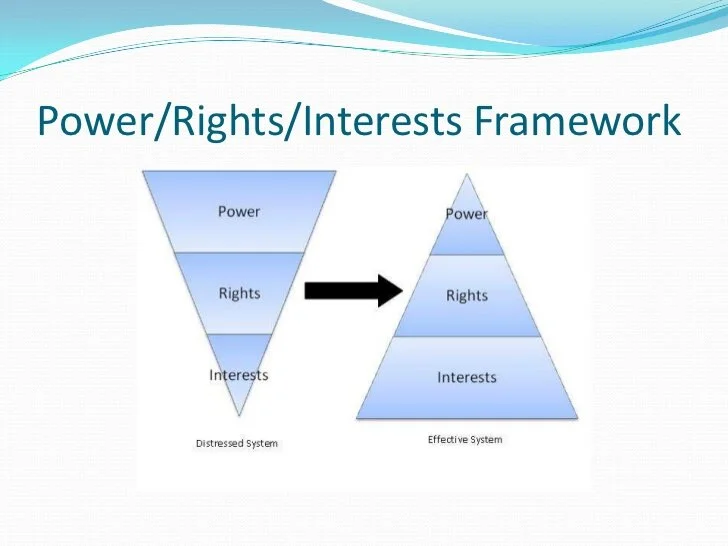
As the image above shows, the best structure is when power becomes a more minor player in the conflict resolution process and interests are what disputants emphasize as they work things out together. The pyramid on the right is grounded, balanced and strengthened by attention to interests. In your workplace, family, organization, which of the two depictions fit your situation? If you want to have a more healthy and productive structure, don't focus on positions but look more deeply to find the individual and collective interests.

Do this:

  • Do you remember the story of the orange conflict? Look at it again to consider positions and interests video.

IMG_1830.jpeg