

MAKE FRIENDS WITH YOUR FEELINGS

WHILE WE ARE KEEPING SOCIAL DISTANCE AND HAVE A LOT OF TIME ON OUR HANDS, LET’S DO SOME CONFLICT RESOLUTION…

Triune Brain.png

MAKE FRIENDS WITH YOUR FEELINGS

Figure out feelings. Understand conflict.

Feelings are an important component of understanding, analyzing and handling life's conflicts.

Your brain and your emotional life

There's a wide variety of feelings and words that describe feelings. They are derived from the five core emotions: joy, anger/rage, fear, surprise, and sadness. The absolute reality is, the emotions are always there and whether we accept their existence or try to avoid them (see Day 2) everyone has a rich, varied and complex emotional life.

The limbic system, which developed much more recently in evolution after the nervous system and brain stem, is where the emotional life resides. After that, and much more recently in evolutionary terms, came the logical brain. The reality is, although the logical brain can try to dominate the feeling brain, the emotions can and will always take over. We survived as a species because of the feeling brain--it is essential for our existence.

Make friends with feelings

Feelings are an important component of what makes everyone human. Some of us have been taught that we should push down or ignore feelings, that any emotional expression or acknowledgment of our feelings will indicate our own personal weakness. Nope. Your hard work is to understand where your individual feelings come from. This is your lifelong job. We are all responsible for what we do with our feelings, no one else. And we can't take responsibility without spending a bit of time examining our own personal emotional life. Its not a quick process and requires learning how to self reflect. Relax. Look inward. Give yourself a break.

Name that feeling

We describe our feelings with a myriad of vocabulary terms. Only the individual person can pick the accurate term. Below is a list of feeling words, take a look and broaden your vocabulary. Naming an emotion has a powerful effect. Saying to yourself, I am feeling frustrated and also a bit hesitant is a much more developed internal dialogue as compared to the basic sad•mad•glad construction. Our words clarify our narrative. Our narrative has a big effect on how we approach challenges.

Feelings and conflict

First the internal part. If you are having a conflict and you are participating in the conflict, your emotions are tied up with some component of the conflict. We don't have conflicts if we don't care. And caring comes from an emotional place. Ask yourself some self reflective questions. What am I feeling? Do I know why I am feeling this way? Does it fit a pattern? Is there a long term memory involved?

And before you do or say anything you can't take back, consider the other person and their feelings. What are they feeling? Why do you think that is so? Can you check to see if you are right? Exploring feelings, with a light touch, both internally and with the other person can help to set the stage for productive communication and problem solving.

Emotional hijackers

One important part of the limbic system awesomeness is the fight•flight•freeze trio of hijackers. When we are highly emotionally charged, one of the those three take over. Big idea: It takes 20 minutes or more for you or anyone else to get back to normal after a fight•flight•freeze event. 20 minutes--not 30 seconds. That means in a conflict, you need to let yourself and the other person take a very long break before trying to engage your cerebral brain and work to resolve the conflict.

Conflict resolution and emotions

When you are engaging in a difficult conversation, find the right place to insert your own feelings. Here's a sometimes successful technique. Decide what you are feeling. Ask the other person, Would you like to know how I am feeling? If they say no, do not offer it. If they say yes, tell it in a neutral and not blaming way. If another person tells you how they are feeling, accept it as entirely and fully true. Never deny someone is feeling the way they say they are feeling. On flip side, don't take responsibility for other's feelings. We are all responsible for our own feelings. Other's actions affect us and may be the reason for the feeling. Blaming others for how you feel is counter productive. It does not help and sets up a lose • lose scenario.

Do this:

  • Take a look at the feeling list (below). Set your timer for an interval of time--maybe an hour or two. As you go about your day, check in regularly on your emotional inner life. Write down the feeling words that best describe you throughout a few days. Is your list widely varied? Are you finding terms that fit you on both lists--needs satisfied/needs not satisfied?

  • If you are seeing the same feeling word listed often, take some time to think about that feeling. Is there a pattern in your life that is related? Do you need someone to talk to about this?

  • Listen when someone says they are feeling a certain way and accept what they are saying. You can respond by saying,

  • Is there a way I can help ? (action) or

  • I'm sorry you feel that way. (empathy) or

  • Let me know if you want to talk about feeling _____?(communicate).

  • Tell the conflict story, either to yourself on paper or in recording or to another trusted person. Make sure to describe your feelings. Can you figure out what needs, values or aspect of identity the feelings relate to? This is your conflict narrative. By reviewing our own conflict narrative, we can sometimes figure out a new a creative approach to resolving the conflict.

Quick read on the five core emotions here: Emotions and feelings

A list of feelings organized for conflict analysis Feelings inventory

Here's a long clip from the movie Inside Out--brilliant tutorial on emotions Inside Out: The Movie The clip is a bit disjointed, better to watch the whole movie if you can.

Yesterday's video clip didn't work right. Here it is Listening TED talk

Tomorrow there will be a quiz! It will be fun...I hope.

Learn To Listen Better

WHILE WE ARE KEEPING SOCIAL DISTANCE AND HAVE A LOT OF TIME ON OUR HANDS, LET’S DO SOME CONFLICT RESOLUTION…

Learn To Listen Better

dog pic.jpg

Want respect?

Listen better.

Think of people you admire. A leader, an expert, a mentor, someone you can rely on. What do these people all have in common? They are good at the skill, art, craft, and science of listening.

The skill of listening

Just like any skill, it takes practice, practice, practice. Try a self-improvement listening project - build your listening muscles. Face another person. Turn off your other thoughts. Postpone conclusions and judgements. Open up your mind to the other person and work hard at listening. Want to check how you are doing? Paraphrase or repeat back to the person. Say, "I'd like to see if I've got it. Is this what you just said?" Say back what you think you heard and see if the person recognizes their message.

The art of listening

Use your creative self while you work to be a great listener. Make pictures in your mind of what the person is saying. Not your own story, their story. Zone in on body language and tone--do you see or hear something that provides more information beyond the words?

Keep track of your own body language. Stay calm and open to what is being said. Find your own creative system to stay on track with what the other person is saying and what the meaning is behind the words.

The craft of listening

There are rules and structures that work if you want to be a good listener. Find a good place for a talk, don't try to multi task--you can't, no one can. Make encouraging moves or sounds, to show you are there with the speaker and that you are interested and listening.

With difficult topics, ask if you can summarize or paraphrase what is said. Don't let your answer, conclusion or personal experience emerge to hijack the conversation. Listening is not about you, it is about the other person. In your mind, think about these questions: What are they saying? What are they not saying? What are you learning about the person? Why are they telling you this? What do they seek from you as the listener?

Then ask questions--good solid real questions. First clarify information. Find out facts or check on details that are important to understand. Then ask deeper questions that are more open ended. Don't tell your own story. Don't provide your judgement. Don't tell the person what to do. Don't diminish the person or their values. Lift them up with the gift of your attentive listening.

The science of listening

Two people, sitting together and talking is a balm for life's wounds. We are social beings. We need to know someone appreciates our own ideas and experiences. Listening equals empathy. Blood pressure improves. Adrenaline and stress response returns to neutral. Muscles relax. Breathing calms. A warm feeling of calm develops. Trust builds. Respect increases. It's pretty amazing the actual physical and psychological effects that being listened to can have.

Here's the surprising part. The listener receives all the above positive effects along with the listened to person. We mirror each other's status when we spend time together. When you open your mind to listen to another person, it benefits you too. And if you have to be on a video call or phone to talk, use your voice to promote togetherness and calmness.

Conflict resolution and listening

Professional mediators, conflict coaches and others in the conflict resolution world know that their first and most important tool in the tool box is listening. This is how we do our work, looking underneath the words for the most important information--the needs, interests, values and identity of the speaker. If we are good at listening, there's no room for our own agenda or personal biases. We open our minds and do our very best listening in order to find potent foundation upon which to resolve conflict.

Do this: Ask someone in your life to help you to become a better listener. Ask the person to notice if you are listening well or not. Try to paraphrase - repeat back - what someone says.

How did you do? Are you picking up what the other person is saying or substituting your own ideas and vocabulary? Stick with it and be easy on yourself. Practice makes a little better -- there is no perfect. We are all in training.

  • Listen for figurative language to understand better what the person is saying. Do they use more sports, gardening, travel, boating vocabulary?

  • Watch their body language, what do you see?

  • Work on your follow up questions, removing your own judgement and conclusions--really ask to hear the other person's thoughts and ideas.

  • Don't let yourself believe you are multi tasking--especially when someone is trying to talk with you about something important. Give them your full attention. Put the phone down.

Watch a video about the craft and science of listening here--watch till the end for the RASA approach: Listening Ted Talk.

Or read an article Listening to loved ones or Listening at work

Our Conflict Style

WHILE WE ARE KEEPING SOCIAL DISTANCE AND HAVE A LOT OF TIME ON OUR HANDS, LET’S DO SOME CONFLICT RESOLUTION…

Our Conflict Style

The Conflict Matrix

The Conflict Matrix

There are five main styles of conflict. Some are more effective than others. For those who feel uncomfortable with spending time handling conflict, its time to consider other methods of conflict resolution.

Many people use the AVOID conflict resolution style. They think its the safest option. When there is a major power imbalance between disputants or if there is not time or energy, avoiding dealing with the issue might make sense. The problem is, the conflict doesn't go away. Over time it gets worse. The ostrich with its head in the sand doesn't accomplish much except to hide from the problem.

We all know a COMPETITIVE conflict resolver. They want to win, the conflict is a battlefield and they are planning to win and you are going to lose. People who compete when there is a conflict don't accomplish much except to dominate the other person. This causes resentment and misses out on the ideas of the other person. Taken too far this can become a bullying scenario, driven by a need for power. Not a great way to truly resolve a conflict.

The flip side is the ACCOMMODATE conflict resolver who gives in to the other person and does not assert their own ideas and needs. Someone who always accommodates others is the person who is not being heard and considered. This style, overused, is going to lead to low self esteem on the part of the accommodating person--and a pattern of not truly communicating with the other person.

Our work is about moving conflict away from the outer frame in order to build experience with conflict as a positive process--moving toward well-discussed and agreed-to COMPROMISE and COLLABORATION.

When people compromise, and if the outcome results from a fully developed conflict resolution process, its an improvement compared to the first three styles listed above. Everyone loses a bit and everyone wins a little. At its best, the process will help to build the relationship and both people can appreciate learning about each other.

If the disputants have the time and can listen to each other, the strongest and most equitable is the collaborating style. Applying this approach means the disputants remove the shame and blame from their thinking, define the conflict together, put the topic in the middle of the table and work together to come up with a creative solution. They ask each other: Why do you want what you want? and Can we think of another way? They work together on the conflict as a project, using creative thinking in order to move toward a Win-Win outcome.

Do this: Spend some time thinking about the Conflict Styles with this matrix available as a reference. Do you see these styles in evidence? How often do you see each of the five styles? Which do you use and when and why?

Try using Creative Problem Solving/Collaborating. Pick a really low level conflict. Try to work together with the other person to come up with a new and interesting way to resolve the conflict. Be creative together.

Consider the connection between having a positive attitude toward conflicts and the ability and willingness to think creatively.

Watch a video about the conflict resolution styles here: Conflict Styles video Or read an article here: Conflict Resolution styles

Our Thoughts About Conflict

While we are keeping social distance and have a lot of time on our hands, let’s do some conflict resolution…

Our Thoughts About Conflict

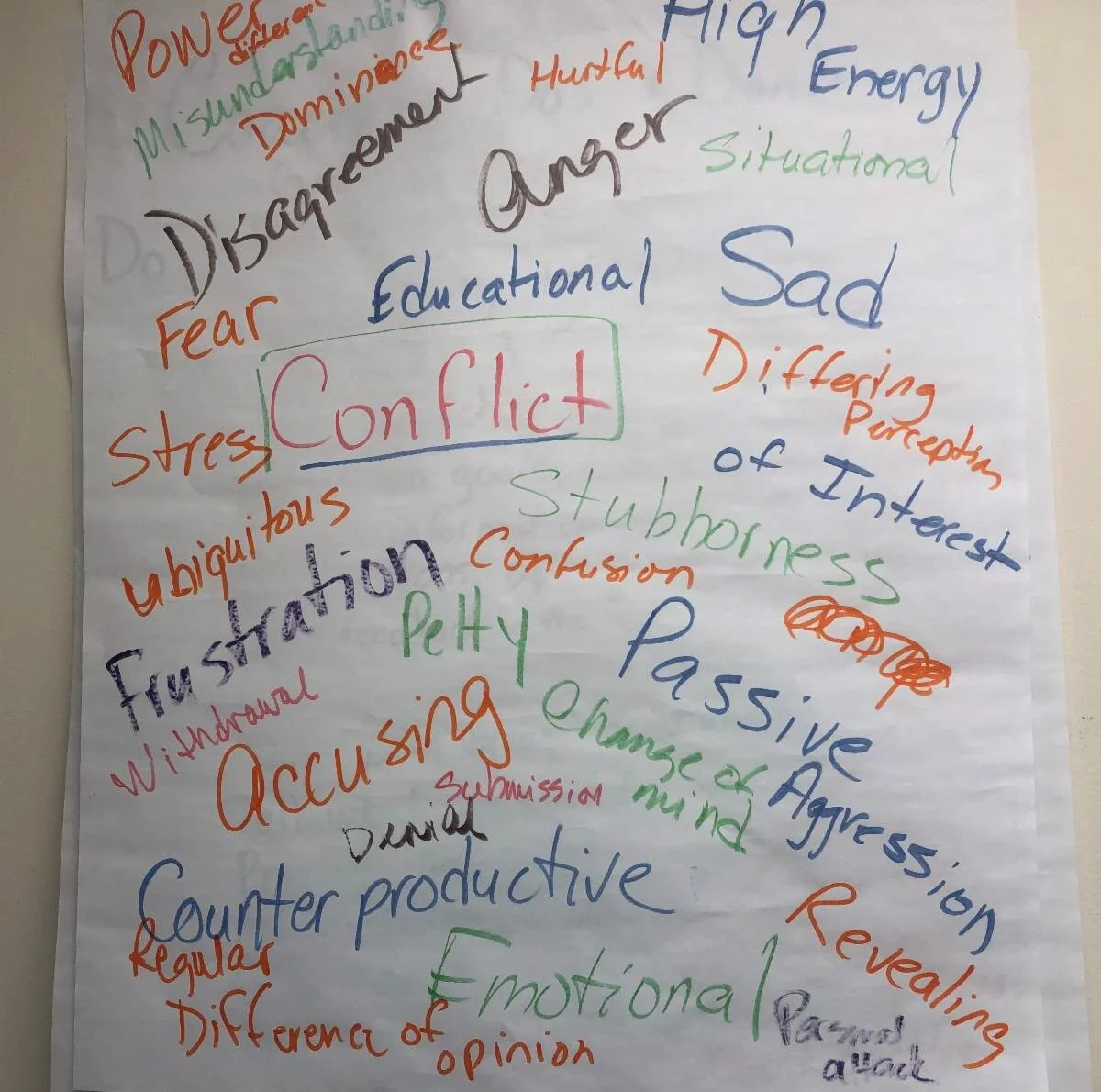
Conflict Web

Working with groups, we often start by gathering words associated with the word conflict.

After we have created a Conflict Web, we ask: What do you notice here?

'Its all negative'. 'Bad'. 'Conflict is not welcome'. 'We don't like conflict!'

When folks start mining their memories for messages they have adopted about conflict, they often uncover the incomplete and unhelpful ideas that are prevailing in our world.

Our work is about moving conflict concepts away from the lose-lose mentality to a new conflict metaphor.

  • Conflict as a problem to be solved

  • Conflict as an opportunity

  • Conflict as a time to learn

  • Conflict as a gift.

  • Conflict as...(a garden? a journey? a house?...)

Do this: take a piece of paper and write down all the words you associate with conflict.

Try to come up with a list of conflict metaphors. Be creative!

Consider where these messages came from in your life.

Read an article Conflict Metaphors

Conflict Coaching Can Work for You

Sara Barnes, Lead Mediator

Over this past year we have been building our Conflict Coaching service. MVMP has our own model called CLAMSHELL. In two hours of 1:1 coaching, participants can review a conflict scene, analyze many aspects of the conflict and develop a personalized plan for the future.

Who benefits from Conflict Coaching? Our clients are diverse. Some are:

  • a divorcing mom who wants to not shut down when dealing with her ex partner

  • a public official who wants be more effective when confronted with anger

  • a mother of the groom to who wants to better handle an upcoming family wedding

  • a wife who gets angry whenever she and her husband discuss an ongoing topic

  • a supervisor who finds herself reactive to the actions of a particular employee

These conflicts are the stuff of everyday life. Our clients come to us seeking self improvement. They work with a caring and qualified coach who leads them through the coaching protocol.

The CLAMSHELL letters stand for the steps that happen sequentially as the coach and client move through the conflict coaching process.

  • Clarify Goals

  • Listen to conflict story

  • Ask to understand

  • Map the internal & external

  • Survey mutuality

  • Heartcheck & Reflect

  • Explore Options & Rehearse

  • Lock it in

  • Look for Pearls

We have learned quite a bit over the last year from our Conflict Coaching clients. The close bonds between coaches and clients open up reflective dialogue. Here are a few important findings so far:

1:1 time

Just the process of sitting for two one hour sessions with another person, being listened to and treated with kindness has great value. For many clients, taking a break from busy lives, and focusing inward has powerful benefits.

Pick a conflict scene

Our process asks clients to set a goal and then pick a specific scene to review. The concise nature of picking one important conflict scene helps clients and coaches to focus in a targeted way. In two hours no one can change everything, but focusing closely on a well-defined incident has the benefit of helping the client to zoom in on the underlying forces behind the conflict.

Two sessions

The time between sessions provides time for participants to think things through and develop new perspectives. The second session is often the session where clients have revelations about conflicts in their life.

Mutuality

The beginning of the second session is when the coach leads the client to walk in the other person's shoes and to use the concept of mutuality. This tool is new ground for some people. Our coaches are excellent at helping their clients use this tool as a way to understand their own conflict situation.

If you know someone who you think could benefit from CLAMSHELL conflict coaching, please send them our way. Throughout 2020 we are providing the first two sessions free of charge, thanks to a grant from Newman's Own Foundation.

We can all use a assistance in dealing with conflicts--Conflict Coaching can be that helping hand.